Plan for the local map results and the AI answer. Buyers can move between finding a nearby provider, understanding a problem and comparing their options. Check what appears for those different questions so you improve the right profile or page before another business earns the enquiry.
A search for a nearby plumber may present a different result from a question about replacing a water heater. The exact display can vary by query, place, device and time. Avoid building a client plan around a claim that one feature has permanently replaced the other.
When does Google show an AI Overview?
Google decides whether the feature is useful for the particular search. Its AI features guidance describes different experiences and supporting links. A question can show a map, an AI response, ordinary results, several features together or neither of the features you expected.
Use examples as test prompts rather than predictions. Try “[service] near [town]”, “What should I ask before [job]?” and “What affects the cost of [service] in [area]?” Save what was actually shown and when. Do not label every informational question an AI Overview query without observing it.
Why can a business appear in one result and not another?
The results serve different requests and use different presentation and selection processes. A map position does not establish that the business will be named in a generated answer. A cited service guide does not establish a strong position for a nearby-provider search.
Record the business, page and result type separately. That lets you distinguish a profile issue, a missing service explanation and a question for which no appropriate evidence was available. It also prevents a blended number from hiding a useful weakness.
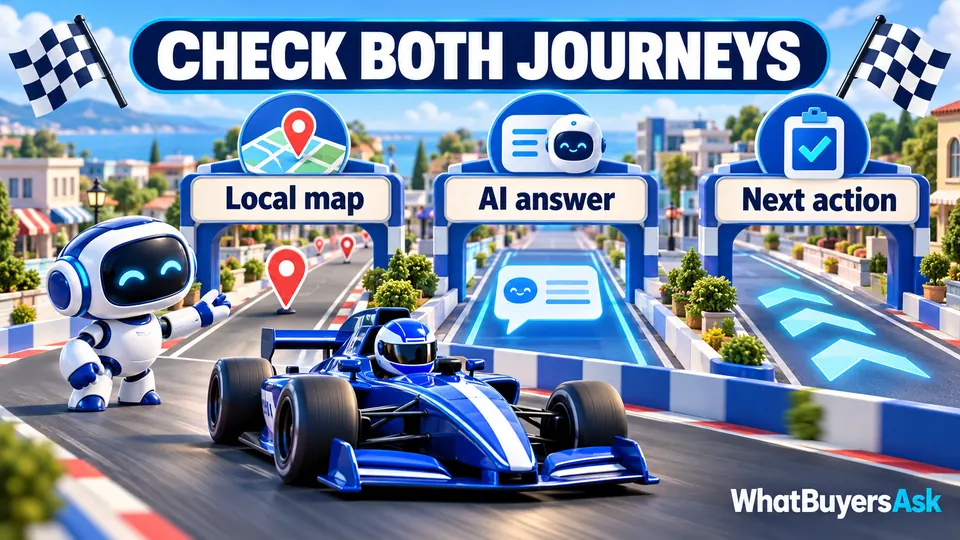
Check both journeys: Local map, AI answer, Next action.
How does Google rank local businesses?
Google's local ranking guidance describes relevance, distance and how well-known a business is. Accurate profile information helps Google and customers understand what the business actually offers. There is no legitimate way to pay Google for a better local ranking.
Confirm the real business name, category, hours, contact route and service area. Keep location details within the platform's rules. Do not create an address or claim a staffed office simply to appear closer to customers. Real local detail is useful to a buyer; a fictitious location creates a misleading expectation.
Request feedback neutrally and follow the platform's policies. Respond helpfully without disclosing private customer details. Current photographs and clear service information can also help someone decide whether to contact the business.
What belongs on the website?
Explain the services customers actually buy. Give each significant decision enough detail: what is included, where the business works, relevant price factors, availability limits, qualifications and how to request a quote. Put important facts in readable text and connect the explanation to an appropriate enquiry route.
For a hypothetical roofing business, an emergency repair page could explain the area covered, how the initial assessment works and what information to send safely. A replacement guide could explain the factors affecting scope and quotations. Neither page should invent a response guarantee or a price the business has not approved.
How do I choose which gap to fix first?
Match the gap to the commercial decision. A wrong phone number needs prompt correction. A high-value service with no useful explanation may deserve a better page. A generic informational article with many impressions may need a clearer link to the relevant service.
Use this review routine:
- Save a fixed set of genuine or clearly labelled illustrative buyer questions.
- Record the town, date, device and visible result types.
- Save the profiles and exact pages named or cited.
- Inspect the most relevant missing or incorrect information.
- Make a small, documented improvement and repeat the comparable checks later.
Check more than the view from your office if you serve several areas. Keep a realistic, explicit location in the question and describe the testing method. An observation from one street or one session is not a map of the whole market.
Do AI answers reduce clicks?
The effect depends on the search and the audience. Do not assume that a visible answer either destroys demand or delivers a visit. Monitor your own recorded exposure, website activity, calls and bookings. Some customers act through a profile without first visiting the website.
Use GA4's source data and available profile reporting alongside enquiries. A phone-link click is not a completed call, and a direction request is not a booked job. Keep those steps distinct when discussing business value.
How does AI search change the agency's plan?
Add a question-and-source review to the local search work you can already verify. Keep accurate profiles and service pages useful to buyers. Inspect where the generated answer points, then choose improvements supported by the client's actual services and evidence.
Report a clear before and after: the original question, observed result, change made and follow-up observation. Include the limits of the sample. A competitor appearing once is a reason to inspect, not proof of a permanent advantage.
What is the map pack?
It is the local business-and-map feature shown for many local searches. The display can vary. Record the actual result rather than assuming every search shows exactly three businesses.
Does a good Google profile guarantee AI citations?
No. Keep the profile accurate because it helps customers and local discovery, then test AI source selection separately.
How do I get into an AI Overview?
Keep relevant pages accessible, accurate and useful, and review Google's current eligibility and inclusion controls. There is no guaranteed inclusion or special markup that forces selection.
Should every town have a separate page?
Create one only where there is useful, accurate local information to explain. The service-page guide shows how to avoid thin variations.
Where should we start with WhatBuyersAsk?
Choose the client's correct type and save the service areas for Local business AEO. The research can then keep the question scope and directory evidence tied to those places. Local editorial patterns remain labelled separately from observed customer questions.
Give the next buyer a clear explanation and a credible way to make contact. Read how research works, create your workspace, or sign in for an existing client.