Compare the services you actually sell with the information a buyer can find on your website. If a valuable service appears only as a bullet point, a prospective customer may choose a provider who explains it properly. Start with that information gap before adding another general blog post.
Imagine an electrician who installs EV chargers every week but describes only “electrical services” online. The business has experience, yet its site may leave the buyer unsure about charger installation, the area covered, the assessment and how to request a quote. That is a practical content problem an agency can investigate.
Why might our site be missing from an AI answer?
There can be several reasons: access, relevance, source selection, inaccurate public information or insufficient explanation. A missing service page is one possible gap, not a diagnosis you can make from one answer. Save the question and sources, then check the relevant pages.
The right test is whether a buyer can understand the service you genuinely offer. A competitor's citation can reveal useful information to inspect. It does not prove that copying the competitor's layout or publishing a new URL will produce a recommendation.
How do I identify content gaps?
Build the service list from approved business records, actual quote requests and staff knowledge. A profile's service menu can be a starting point, but confirm it reflects work the business really does. Keep private customer details outside the public content brief.
Use a worksheet with these columns: service, buyer question, existing page, coverage status, evidence available, business priority and proposed action. Mark coverage as useful, partial, missing or not yet assessed. A page your team has not reviewed is not automatically missing.
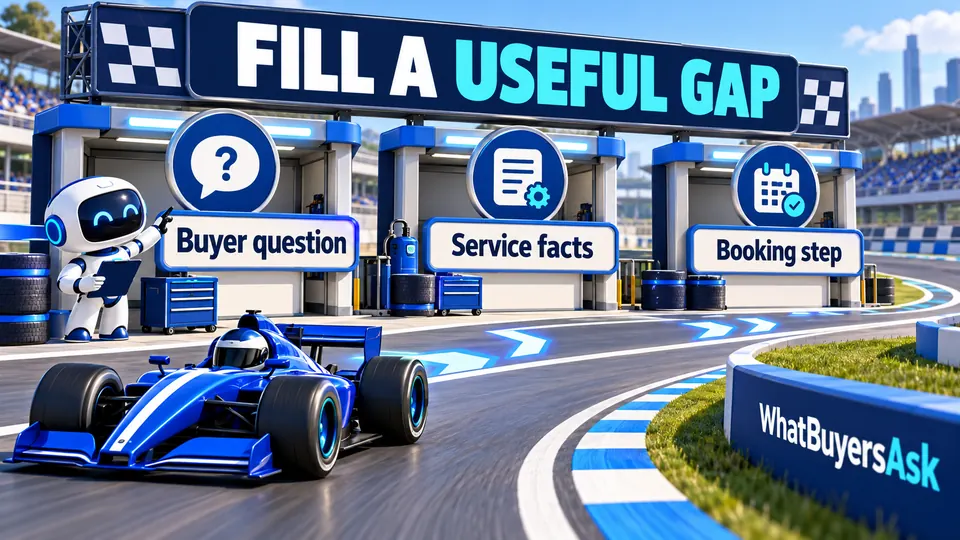
Fill a useful gap: Buyer question, Service facts, Booking step.
Which missing pages should we prioritise?
Start with the combination of a real customer need, commercial importance and reliable information ready to publish. A service that creates frequent qualified enquiries may deserve attention before a rare variation. Correct wrong contact or availability facts promptly even if they do not require a new page.
Ask four questions for each proposed task. Does the business offer it? Do buyers need a distinct explanation? Can the team supply accurate details? Is a separate page more useful than improving an existing section? Record the reason rather than assigning an unexplained priority number.
How do I write a useful service page?
Explain the service, who it is for, where it is available and the next step in the opening paragraphs. Then answer the practical concerns that affect a decision: what is included, what changes the price, what an assessment involves, timing limits and relevant credentials.
A hypothetical opening might say: “We install home EV chargers in [actual area]. The assessment checks the property and electrical requirements before a quotation is agreed. Contact the team to discuss the installation and what information to provide.” Replace every placeholder with approved facts. Do not invent a price, licence, service area or response guarantee to complete the template.
Support the explanation with genuine work examples and photographs where permission allows. Keep important text available in the page response, not only inside a graphic or a booking widget. Link to a working contact or quote route that makes sense for the stage the buyer has reached.
Should we create a separate page for every question?
No. Group questions that help the same buyer make the same decision. A substantial service can have its own page, with sections covering price factors and process. A small variation may belong on that page rather than becoming another URL.
Create location pages where there is useful, accurate local information: real coverage, a legitimate team, relevant local requirements or approved examples. Google's spam policies address doorway abuse. Near-identical town pages created mainly to capture searches are a poor basis for a useful buyer journey.
Does topical authority matter?
A label such as “topical authority” is less actionable than checking whether the site answers the important questions accurately. Improve the explanation where it is weak, add evidence the business can support and link related pages so a customer can explore naturally.
Do not promise a certain number of pages will produce AI citations. Word count, a completed topic map and a schema check do not demonstrate that an assistant will select a page. Treat those as inputs to a useful site, then inspect the resulting observations separately.
How should the agency run the work?
Use a short, reviewable sequence:
- Verify the service list with the client and mark assessed coverage.
- Select the most useful gap and agree the page's buyer decision.
- Collect approved facts, examples, price conditions and the next action.
- Improve an existing page or draft a distinct new page as appropriate.
- Obtain the relevant business or professional review and publish through the agreed process.
- Recheck access, links and the fixed buyer questions, then review enquiries.
Keep the original question set for comparable retests. A new service or area may need a new baseline. Record what changed rather than treating a different set of questions as evidence of improvement.
What does a good service page look like?
It gives a buyer the service facts and a clear next step quickly. It includes accurate scope, location, price factors and process, supported by details the business can verify.
Are service pages important for SEO and AI answers?
They can provide useful information for relevant searches and questions. Their existence alone does not establish ranking, indexing or recommendation. Review access and actual evidence as separate checks.
What's the difference between a service page and a landing page?
A service page usually explains an ongoing offering. A landing page is designed around a particular arrival and action. Either can be useful when it answers the buyer's need accurately and connects to an appropriate next step.
What are doorway pages?
They are pages created to target similar searches while taking people toward essentially the same destination. Review the current policy and avoid generating thin location variations that add little for the customer.
What if the research says a page is not assessed?
Review it before commissioning a replacement. Not assessed, unavailable and missing are different states. A content plan should preserve those distinctions so the client pays for useful work.
WhatBuyersAsk helps agencies connect 40 critical buyer questions with saved evidence and page opportunities for the agreed scope. Turn that research into a focused brief your client can review. Read how it works, create your workspace, or sign in.