Get the next useful answer off the starting grid.
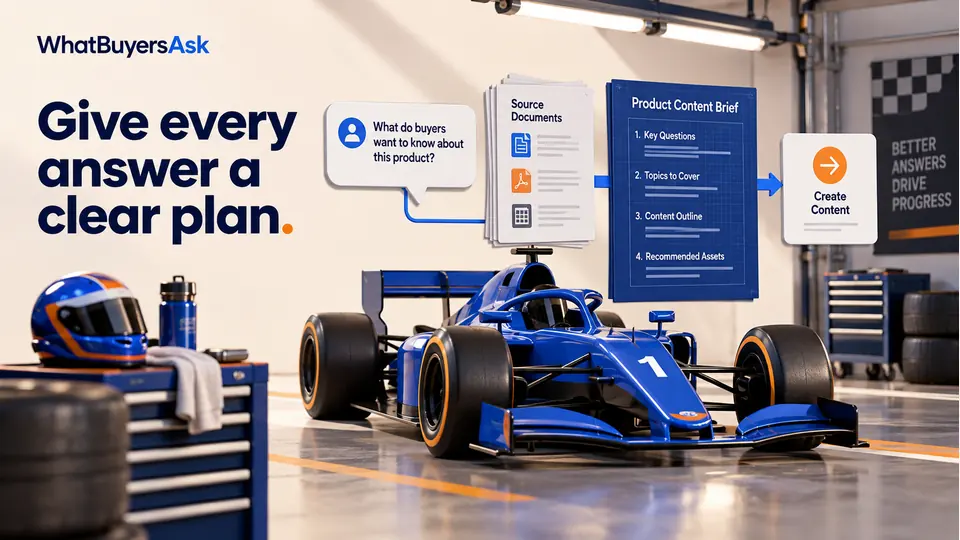
A vague brief can turn a buyer question into another round of revisions. Give the writer a page goal, required answer, supporting evidence and next step so the work can move with a clear purpose.
A brief built around the buyer’s decision
Start with the buyer ask and intent, then map the page goal and structure that will answer it.
- Why act now
- A topic title alone can leave the writer unsure what the reader must learn.
- The draft can grow without resolving the buying question.
- A better position
- The brief has a question, page goal and required answer.
- How it helps
- Define the buyer's decision before outlining the page.
- The writer has a clearer scope.
- Business benefit
- Help the next draft resolve a question that can affect a sale.

Review the steps and detail in this section, then ask to inspect an example relevant to your business.
Get startedClear intent
Understand what the buyer is trying to do.
Aligned goal
Define the outcome the page should drive.
Logical structure
Outline a flow that answers in the right order.
Track the right measures across the full buyer journey. Show what is working, what is not and why.
Why it matters
Connect activity to business outcomes so buyers can understand the value and make a confident decision.
- Choose measures by buyer stage.
- Explain what each signal means.
- Connect evidence to the next decision.
Help the writer make the answer credible
Surface the right evidence—and the gaps—so the writer can build a trustworthy answer.
- Why act now
- An outline can ask for proof without showing where to find it.
- The writer can fill the gap with unsupported claims.
- A better position
- The brief points to the evidence the answer needs.
- How it helps
- Connect the required claims with sources and proof requirements.
- The writer can see what supports the explanation.
- Business benefit
- Give the buyer a supported explanation they can assess with confidence.

Review the steps and detail in this section, then ask to inspect an example relevant to your business.
Get startedCurated sources from real buyers
Show which evidence deserves attention.
Gaps and opportunities called out
Make missing proof easy to spot.
Requirements for credibility defined
Tell the writer what the answer must prove.
How the business delivers and proves the outcome.
VerifiedRelevant category benchmark and method.
VerifiedWhat alternative providers explain more clearly.
OpportunityA claim or example that requires client review.
Unverified- Show the method and definitions.
- Cite relevant benchmarks and studies.
- State limitations and assumptions.
- Use recent, reviewable evidence.
Help the page earn attention beyond publication
Equip the writer with signals that help the page get discovered, cited and chosen.
- Why act now
- A published page can still be hard to discover or connect to related answers.
- Useful content can remain isolated from the buyer's next question.
- A better position
- The page has a clear angle and relevant connections.
- How it helps
- Use the brief to plan the answer, internal links and publication context.
- The content fits the wider site journey.
- Business benefit
- Connect prospects with the next answer they need to keep considering your offer.

Review the steps and detail in this section, then ask to inspect an example relevant to your business.
Get startedSearch-aligned
Target the terms buyers use.
Compelling angle
Stand out from what is already available.
Internal links
Connect the answer to supporting content.
Show a practical measurement framework buyers can apply without a data science team.
Help the answer lead somewhere useful
Define the next step so the page moves buyers forward—not just informs them.
- Why act now
- A clear explanation can end without an appropriate next step.
- The buyer may still be unsure how to continue.
- A better position
- The page connects the answer with a relevant action.
- How it helps
- Choose a next step that fits the reader's decision.
- The action has a reason beyond a generic sales button.
- Business benefit
- Help an interested buyer take a relevant next step with your business.

Review the steps and detail in this section, then ask to inspect an example relevant to your business.
Get startedClear next step
Tell the writer what to ask the reader to do.
Conversion path
Map the journey from answer to action.
Success metrics
Set expectations for the page.
Invite the buyer to review the answer with a specialist.
Buyer asks, answered.
What is a content brief in WhatBuyersAsk?
It is an implementation-ready direction built around one priority buyer ask, the answer buyers need, the proof required and the next useful action.
How is a brief different from a content outline?
An outline organises headings. A WhatBuyersAsk brief also connects buyer intent, recommended answer, evidence, credibility requirements, internal links and conversion.
How are opportunities chosen for briefs?
Briefs begin with priority buyer asks supported by business relevance, answer-gap and competitor evidence, confidence and a clear create or improve action.
Who can create and edit briefs?
Briefs are designed as working handoffs for strategists, content teams, reviewers and approved client collaborators.
Can I share briefs with writers and reviewers?
Yes. The brief keeps the buyer ask, evidence and implementation direction together so each contributor works from the same approved context.
Give every answer a clearer reason to exist—and a stronger next step.
Turn one open buyer question into a brief the writer can use. Give the next draft a purpose before the work begins.