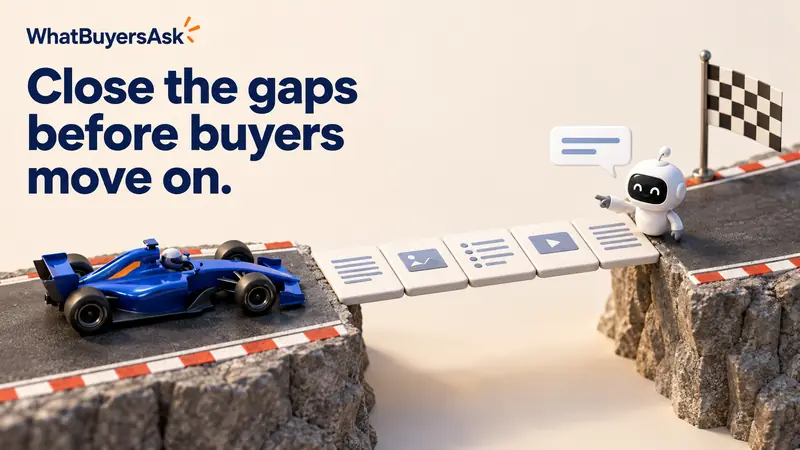
Your next buyer could find a competitor first.
An llms.txt file can organise links to your content, but it cannot substitute for useful pages and reliable access. If buyers discover a competitor while your important answers remain hard to find, the commercial problem is missed attention and a weaker chance of reaching the shortlist.
This three-layer model is a practical way to organise AEO work, not a formula used by every AI engine or a guarantee of revenue.
What are the three layers of AEO?
Build the three layers around the buyer’s next decision.
- Retrievability: AI crawlers and search indexes can reach and read your pages.
- Answer fit: Your pages answer real buyer questions directly and early.
- Third-party corroboration: Relevant independent sources support accurate facts about your business.
Use these layers to investigate gaps. A citation does not require proof of all three in every case.
Layer | Question it answers | Typical work |
|---|---|---|
1. Retrievability | Can the engine get to your content? | robots.txt, CDN rules, indexing, raw HTML |
2. Answer fit | Does your page answer the buyer's question? | Answer-first pages built on real buyer questions |
3. Corroboration | Do trusted sources agree? | Placements, reviews, syndication, consistent facts |
Does llms.txt help you get cited by AI?
Treat llms.txt as an optional experiment, not proof that an engine will select your site. Google's AI features guidance says no new AI text files or special schema are required. Keep useful content and working crawl access ahead of optional files.
What about schema markup?
Use structured data to describe the content that is actually visible on the page. It does not guarantee a citation. Google's guidance requires no special AI schema. This article's useful answers should stand on their own as readable HTML.
What does Layer 1, retrievability, involve?
Retrievability means making sure AI crawlers and the indexes they rely on can actually fetch your content. Check that robots.txt allows the relevant bots, that your CDN or firewall doesn't return 403 to them, that pages are indexed in Google and Bing and that key facts appear in raw HTML.
Check robots rules, response bodies, redirect chains, firewall events and whether important facts appear in the HTML. A successful status code alone can hide a challenge page. OpenAI documents different controls for search discovery, training and user-triggered retrieval.
This is where llms.txt belongs: as one optional item inside Layer 1.
What does Layer 2, answer fit, involve?
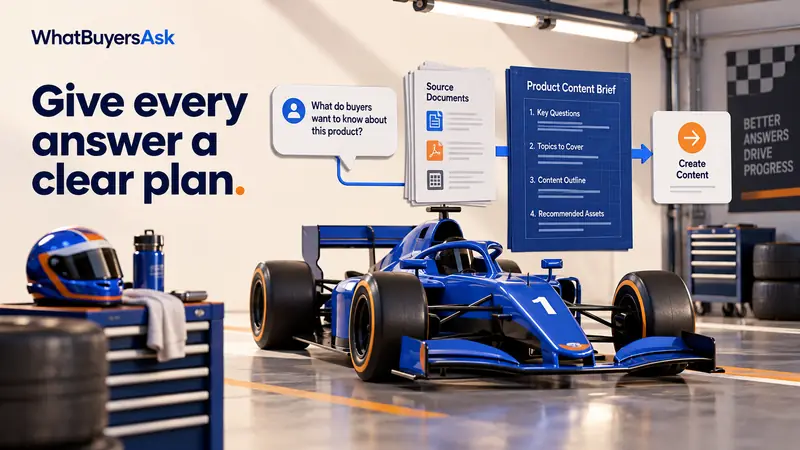
Answer fit means directly answering the specific question a buyer asks, using clear language, supporting evidence and conditions. Put the useful answer early. Explain price, alternatives, suitability, implementation and limitations where those facts are relevant.
The hard part of Layer 2 is knowing which questions influence a purchase. Use sales conversations and customer evidence to choose them; keyword guesses alone can miss the uncertainty delaying a sale.
What does Layer 3, third-party corroboration, involve?
Third-party corroboration means getting your facts onto the sources AI engines already cite for your buyer questions: publishers, listicles, review sites, communities and syndication partners. One useful way to find them is to open the URLs AI already cites for your target query and work to get placed there.
How do you know which layer is broken?
Run a fixed set of 20–30 buyer questions across ChatGPT, Perplexity and Google. If bots are blocked or pages aren't indexed, Layer 1 is broken. If you are retrievable but competitors are cited, investigate answer relevance and evidence; this alone does not identify the cause. If third-party URLs dominate, investigate whether legitimate coverage or accurate external business information would help buyers.
Connect AEO work to sales and revenue
Your next buyer could find a competitor first. Choose the question whose missing answer puts a qualified enquiry or a sales conversation at risk: price, fit, proof, alternatives or implementation. Give that buyer a useful answer and a clear next step.
Track the path from AI referral to landing page, enquiry, qualified opportunity and attributed revenue where your data supports it. Record unattributed enquiries separately. More citations can increase visibility without producing sales; review lead quality and buying intent before celebrating a higher count.
FAQ
Is llms.txt worth adding?
It can be a low-effort experiment when you maintain it accurately. It is optional and does not prove that a service will use or cite it.
Does Google need special AI schema for AI Overviews?
No special AI schema is required. A supporting page must be indexed and eligible for a Search snippet, and selection is not guaranteed.
Does schema guarantee AI citations?
No. Keep markup accurate and consistent with visible content; investigate access, relevance and evidence separately.
What matters for getting cited?
Start with accessible, useful content that answers the buyer's actual question and supports its claims. There is no universal formula that guarantees selection.
Why can't ChatGPT see my site when robots.txt allows it?
A CDN or firewall can return 403 to AI bots even when robots.txt allows them. Test your pages with the bots' user agents and check your server logs.
How do I find third-party sources to target?
Run your buyer questions in AI engines, list every cited URL and prioritize the domains that appear repeatedly, especially those cited when competitors win.
Fix all three layers, starting with the questions
Turn buyer attention into the next sales conversation.
Use buyer question research and answer gap analysis to identify the questions and pages worth improving.
The free research page explains availability; free intake is currently paused. You can use the manual method in this article now.
Discuss your buyer questions and sales priorities
Research supports decisions; it does not guarantee citations, sales or revenue.