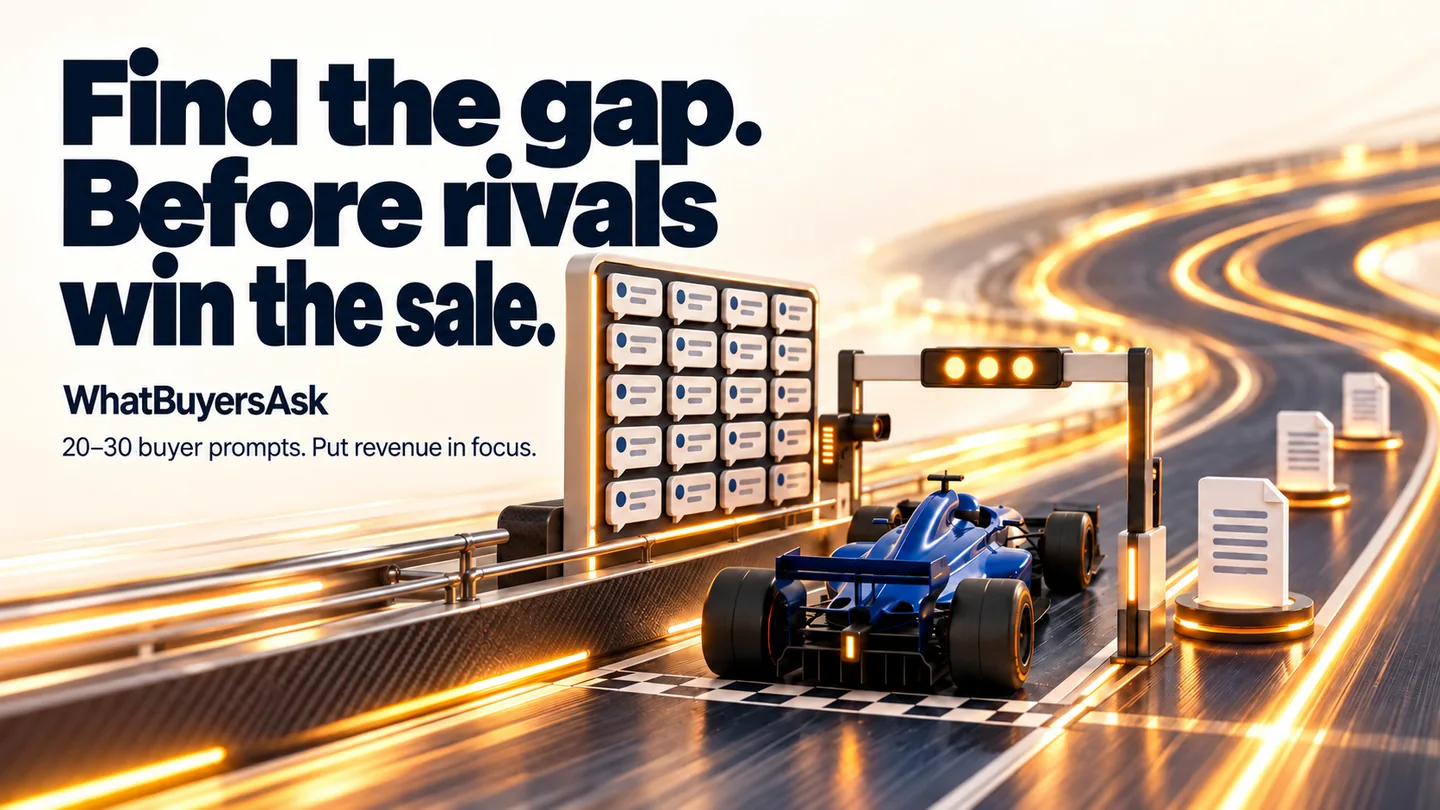
Know which buyer questions put your next sale at risk.
A client asks for "AEO" or "GEO." You've never run it before, and every tool vendor is selling a different score. Before you spend on any of that, you need a baseline: a fixed, dated set of real buyer questions, run across the engines your client's buyers use, with the results written down.
Use this manual method to connect buyer questions to page priorities, sales conversations and, where attribution permits, revenue.
What is an AEO baseline?
An AEO baseline is a dated record of how AI engines answer a fixed set of real buyer questions about your category. For each question and engine, you record which brands are named, which URLs are cited and whether the client is recommended. Every later rerun is measured against it.
Why 20–30 prompts and not 5 or 500?
Twenty to thirty buyer questions is a manageable starting range for this manual exercise, not an engine requirement or statistical benchmark. It's enough to cover comparison, validation and constraint questions across buyer stages, and still small enough to run by hand across three engines and review properly. Five is a smoke test, and a larger set is useful only when you can maintain and review the evidence.
Where do the buyer questions come from?
Buyer questions should come from real buyer language, not from keywords rewritten as prompts. Sources include sales call notes, support tickets, Reddit and review threads, competitor FAQ pages and the follow-up questions AI engines suggest. Group the questions by buying stage so the set covers shortlisting, comparing and validating, not just awareness.
A balanced 25-question set might look like this:
Stage | Example pattern | Count |
|---|---|---|
Shortlist | "Best [category] for [segment]" | 6 |
Compare | "[Client] vs [competitor]", "alternatives to [leader]" | 6 |
Constrain | "[Category] under [budget]", "with [integration]" | 5 |
Validate | "Is [client] good for [use case]?", "[client] pricing" | 5 |
Implement | "How long does it take to roll out [category]?" | 3 |
The counts are a suggested starting split, not a benchmark. Adjust them to how the client actually sells.
Which engines and settings should you test?
At minimum, test ChatGPT, Perplexity and Google (AI Overviews or AI Mode), when those services matter to your audience. Add Claude or Gemini if the client's buyers use them. Record the engine, date, market and language for each run, because answers vary by language and location.
What should you record for each answer?
For each question and engine, record the brands named in order, whether the client is mentioned, cited and recommended, every cited URL, the date and the market. Report results as counts out of the total, such as "named in 4 of 75 answers," and explain the denominator. Keep mention, citation and recommendation separate.
How do you separate retrievability from citation?
Retrievability asks whether AI crawlers can reach and read the client's pages. Citation asks whether the engine chooses those pages when it answers. Check retrievability first: robots.txt, CDN or firewall rules, Bing indexing and whether key facts appear in raw HTML. A blocked request is a reason to investigate access before assuming the content is the cause.
Save the full answer and source URLs, engine, date, market, language, search mode and question version. Keep branded accuracy checks separate from unbranded discovery prompts. Record unavailable answers and absent AI Overviews separately from usable answers that did not mention you. A user-agent probe does not verify real crawler access; check provider-published IP ranges and server logs too.
How often should you rerun the baseline?
Rerun the same question set monthly, on the same engines and in the same markets, and compare results per question. Single runs are unreliable because answers vary between sessions. Only change the question set deliberately, and log the change, so the trend line stays meaningful.
What do you do with the baseline?
Review repeated "not named" or "not cited" results as investigation candidates, not automatic proof of a content failure. Open the cited competitor URLs, find the question they answer that the client doesn't, then fix or create the page that answers it first. Add off-site placements where engines already cite third parties, and report the change at the next rerun.
Measure commercial outcomes alongside visibility: qualified enquiries, sales opportunities and attributable revenue. A citation is not a sale. Track the landing page and next action, note attribution gaps, and avoid claiming a page edit caused a revenue change without stronger evidence.
FAQ
How many prompts should an AEO baseline include?
Use 20–30 as a practical starting set. It is not a formal benchmark; explain the audience and buying stages it covers.
Which AI engines should I include?
Start with ChatGPT, Perplexity and Google AI Overviews or AI Mode. Add Claude and Gemini if your buyers use them, and record the market and language for each run.
Should prompts be based on keywords?
Use buyer questions, not keyword strings. Draw them from sales calls, support tickets, Reddit, reviews and competitor FAQs, and cover the comparison, constraint and validation stages.
What metrics should I report?
Report mentions, citations and recommendations separately, each as a count out of total answers (for example, named in 15 of 102). Avoid single blended scores.
How often should I rerun the prompts?
Monthly, using the same questions, engines and markets. Answers vary from run to run, so compare trends per question rather than reacting to one run.
What should I check before content work?
Check retrievability first: robots.txt, CDN or firewall blocks on AI bots, Bing indexing, and whether key facts such as prices are in raw HTML.
Build your 20–30 question set
Turn buyer attention into the next sales conversation.
Use buyer question research and answer gap analysis to identify the questions and pages worth improving.
The free research page explains availability; free intake is currently paused. You can use the manual method in this article now.
Discuss your buyer questions and sales priorities
Research supports decisions; it does not guarantee citations, sales or revenue.