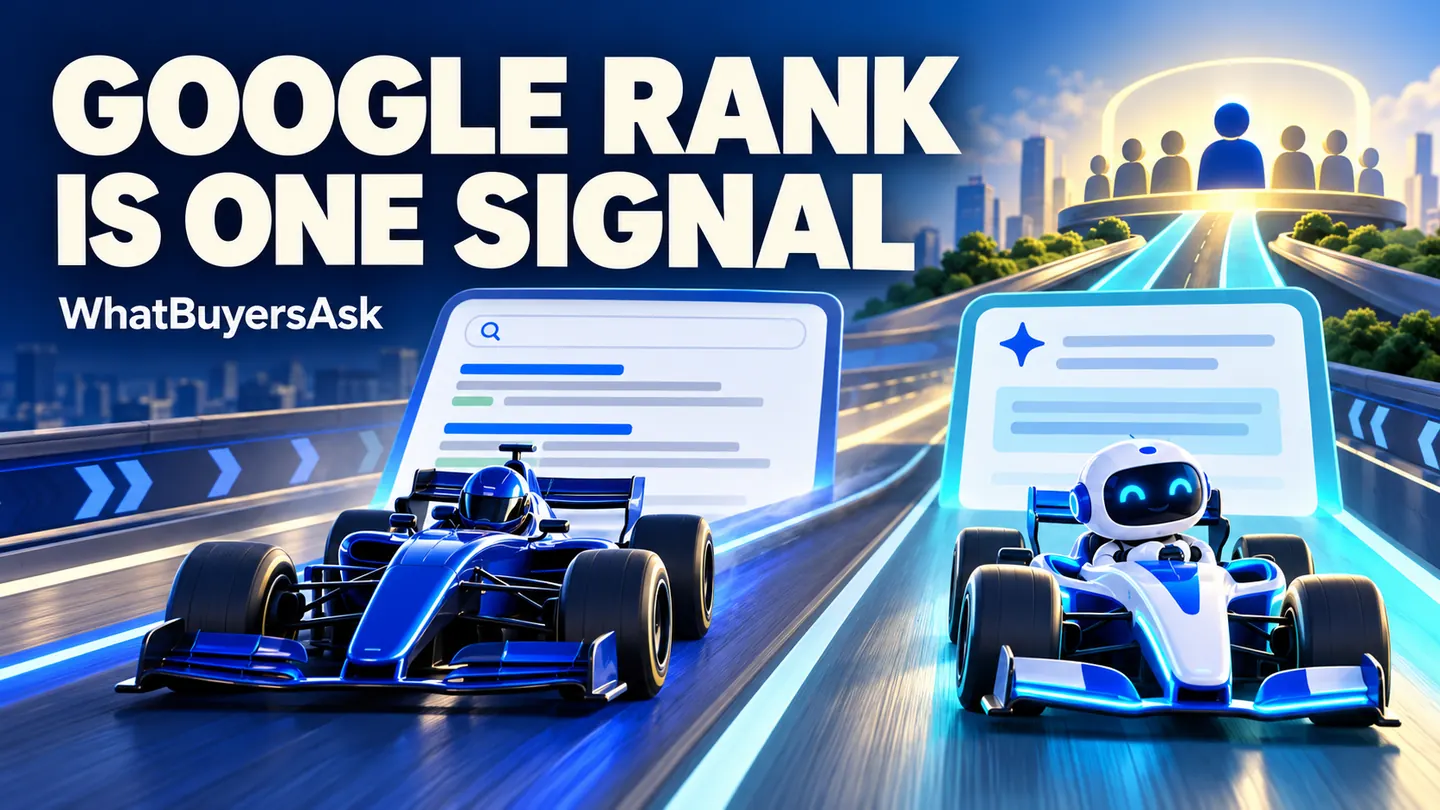
A Google position does not establish that ChatGPT will recommend your business. Check the buyer's question, the actual AI answer and its supporting sources before changing the website. The gap may sit in a particular service, local profile or decision your current pages do not explain clearly.
For an agency, this opens a useful client conversation beyond a ranking report. Keep the search results you can verify, then show where a buyer could still meet another provider first. The next task should follow the evidence rather than a claim that traditional SEO has stopped mattering.
Why can Google rank us while ChatGPT names someone else?
They are different observations. The question, location, time, service and selection method may differ. A strong position for a short keyword is not the same test as a detailed provider question with several conditions. Even the same wording can produce different answers across sessions.
Start by writing down what “rank” means in the claim. Is it a map result, a website result or a rank-tracker observation from one location? Then compare it with the exact AI question. Keep the business name out of the discovery test if you want to learn whether it is suggested without being supplied.
Does ChatGPT use Google or Bing?
Use OpenAI's current search documentation for its described behaviour and partners. Do not reduce the result to “it copies Google's list” or “it copies Bing's order.” The useful evidence for your business is the answer and sources actually returned under the recorded conditions.
Search providers and product behaviour can change. An old technical investigation or a reported partnership should not be turned into a permanent rule about every local recommendation. Preserve the exact source and date when discussing a specific claim.
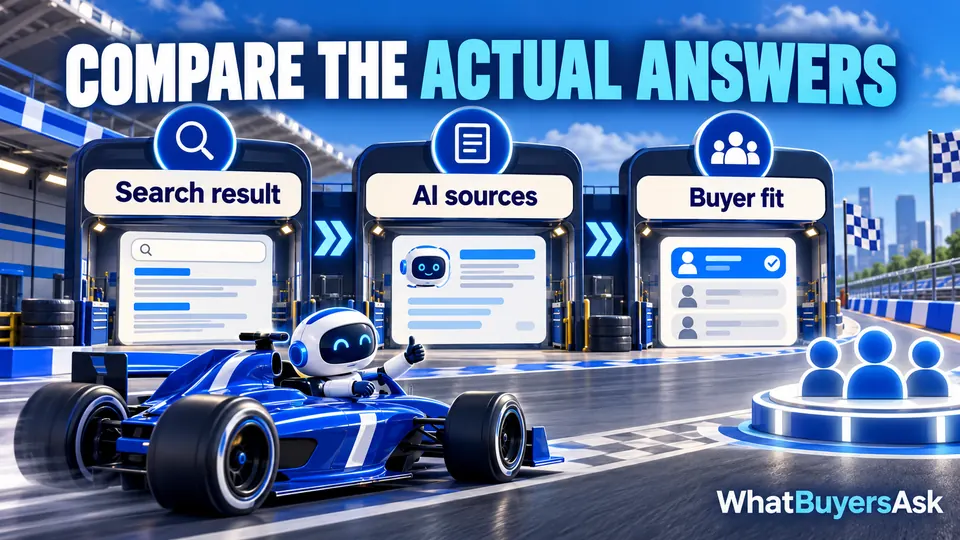
Compare the actual answers: Search result, AI sources, Buyer fit.
How do I compare the two fairly?
Choose a small fixed set of questions covering real buying needs: the service, area, urgency, cost factors and trust. Record ordinary search results separately from AI answers. Where a feature is unavailable or a request fails, keep it out of the count of usable answers while showing the failure.
For each observation, save the question, intended location, service, time and exact source URLs. Label brand recognition, mention, citation and recommendation separately. A business can be named without a useful link, or a page can be cited without recommending the business that published it.
What should we inspect when a competitor is named?
Open the cited page and look for the statement supporting the answer. It may be a relevant service explanation, directory profile, local guide or another source. Confirm it is current and actually about the business in question.
Then compare your own public facts. Can a buyer find what you do, where, relevant limitations and how to get a quote? Is a directory still showing an old service area? Is your site accessible under the tested request conditions? These are concrete inspection tasks. They do not require assuming the competitor has solved every part of AI discovery.
How do I improve visibility if our SEO already works?
Keep the useful pages and local profile work, then address the verified gap. Improve an existing service page where it already serves the right decision. Create a new page where the buyer need is distinct and the client can supply enough accurate detail. Avoid adding thin pages merely to match every variation of a question.
Use a short plan:
- Correct public facts that could mislead a prospective customer.
- Check whether important pages can be reached and read.
- Review the directories and exact sources that appeared in the observations.
- Strengthen the most useful service or comparison explanation.
- Retest the fixed questions and inspect enquiries alongside the saved answers.
Assign each task an owner and a review date. The outcome to pursue is a better informed buyer who can make contact. A changed answer alone should not be reported as a new sale or as proof that one page caused the movement.
Is SEO still relevant?
Accessible pages, useful information, internal navigation and accurate business facts still help people and discovery systems. Google's AI guidance keeps foundational SEO relevant. That does not make a Google position a guarantee of another service's answer.
Treat a ranking as one signal in the client report. Show the buying questions tested, the saved observations, which gaps you inspected and what happened after the change. This is easier for a business owner to assess than a claim that one optimisation controls every platform.
How should we track progress?
Keep questions and service areas fixed for the comparable part of a retest. Save new questions separately. State how many observations were usable and retain actual platform or API model identities. API research is not automatically a logged-out test of a consumer chat interface.
Compare mentions, citations and recommendations within the same defined scope, then review recorded visits and suitable enquiries. If a result is uncertain, preserve that state. An unexplained blended score can conceal a different question mix, missing checks or a change in method.
Does ChatGPT use Google Maps?
Do not infer its source from the fact that a business ranks in Maps. Inspect the links in the actual answer and verify the pages. Keep Google Business Profile accurate for customers while checking other sources separately.
Does the first name in an AI list have a fixed rank?
It is an ordering in that answer, not proof of a stable position for every buyer. Keep the full text and repeat the question before describing a pattern.
Can we guarantee a ChatGPT placement?
No. Commit to accurate content, evidence collection, useful changes and transparent retests. Placement depends on a service's response under conditions you do not fully control.
Is AEO different from SEO?
The work overlaps. Answer-engine research adds a focused check of the questions, answers and sources that could shape a buyer's shortlist. Define what you are measuring rather than assuming the labels imply one universal method.
How can WhatBuyersAsk help?
It helps agencies select 40 critical questions for the agreed client scope and inspect saved answers, available scores and supporting evidence. Use the findings to decide what deserves review, rather than rewriting every page because of one missing mention.
Find the question where a better explanation could win the next conversation. Read the research process, create your agency workspace, or sign in to continue.