A reviews plugin can reassure visitors without making your website eligible for review stars in Google's organic results. Check eligibility before paying for more markup. For a local business, genuine feedback and clear service information should help the customer decide whether to make contact.
Keep three things separate: reviews on the business's own website, ratings on a Google Business Profile and a review-rich result for an eligible page. A valid code test does not make all three behave the same way. That distinction saves a client from buying a result the implementation cannot promise.
Why don't our own reviews produce organic stars?
Google's review-snippet guidance makes self-serving LocalBusiness or Organization reviews ineligible for the star-review feature. Embedding a third-party widget about the business on its own site does not remove that restriction. Technical validity and feature eligibility are different checks.
The practical step is to identify what the markup describes. Is it a review of the organisation itself, a genuine product, or another eligible item? Keep the page's meaning accurate. Relabelling a business as a product merely to seek stars would misrepresent the content.
Can we display Google reviews on our website?
Review the platform's permissions, widget terms and any applicable professional rules before reproducing content. Where display is permitted, make the review useful to a visitor. Preserve its meaning, attribution and context rather than selecting a phrase that changes what the customer said.
An embedded review can help someone understand a service experience. It does not establish that the same page will receive organic stars or an AI recommendation. Tell the client which benefit the implementation is intended to support and which result remains outside its control.
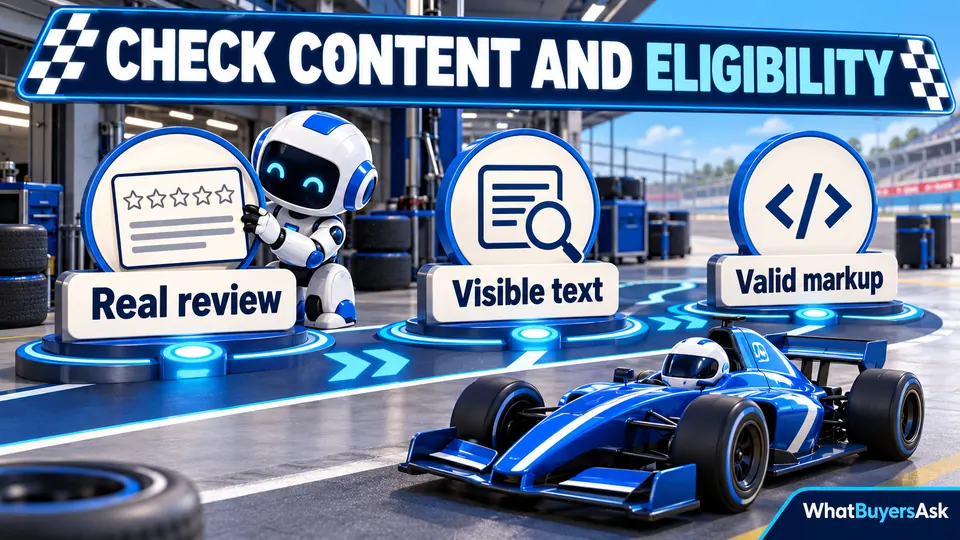
Check content and eligibility: Real review, Visible text, Valid markup.
Is valid review markup enough?
No. Google's structured-data policies require content to be accurate and consistent with what the page shows. Correct syntax does not prove that a review is genuine, that a page meets every policy or that Google will select a rich result.
Run the page through the Rich Results Test. Record the detected item, errors and the plugin or template responsible. Then separately inspect the visible review, rating and count. A passing test should be described as a technical check, rather than proof of a guaranteed search display.
What should we do with markup already present?
Ask the developer to identify its purpose and source. A theme, plugin and widget can each add overlapping data. Compare the facts they publish and correct inconsistent or misleading values. Do not remove all structured data without understanding what else the implementation describes.
If the client was promised organic stars for self-serving business reviews, explain the eligibility rule and agree a more useful objective. A clear page, accurate business identity and trustworthy feedback are concrete deliverables. A particular search appearance is not something a vendor can guarantee.
Where do local profile stars come from?
Reviews on Google Business Profile are a separate feature. Google's review guidance describes how customers can leave feedback and how businesses can share a review link or QR code. Use neutral requests and follow the policy; do not offer incentives or ask only customers expected to leave a positive rating.
Keep review replies appropriate to the business. A practice or law firm should avoid exposing personal or confidential details in a public response. If a profile review is missing, investigate that profile issue separately from the schema on the website.
What makes review content useful to a buyer?
Relevant detail can help someone understand the service, process or communication they might expect. Use authentic excerpts only where permitted. Do not write a customer's review for them or request a particular service phrase, town name or star rating.
Keep the review near an explanation of the actual service and a clear next step. A reader comparing quotations may need to know what is included and how the assessment works. A star badge alone cannot answer those questions.
Does schema help with AI search?
Accurate structured data can describe content, but it does not force an AI service to cite or recommend the business. Review the page's readable facts and the source evidence in actual answers. A green schema check and a successful bot fetch are useful technical observations with narrower meanings.
Use the access-check guide if important review or service text appears only after scripts run. Do not assume that every assistant executes the same scripts as your browser. The goal is an explanation people and supported fetchers can read accurately.
How should an agency perform the review?
Choose a homepage and a representative service page. Save the current display and relevant markup before editing. Check the item being reviewed, the source of the data, the visible facts and the documented eligibility rules. Assign any correction to the developer or content owner best placed to verify it.
After an approved change, rerun the technical check and inspect the page on a phone. Review the enquiry step alongside the content. Then use a fixed set of buyer questions to observe source selection separately. Do not present that retest as proof that review markup caused a recommendation.
What are self-serving reviews?
In this context, they are reviews about a business controlled and displayed by that business on its own site. Read the current eligibility guidance before expecting an organic star feature.
Can products have different eligibility?
Yes, genuine product reviews have their own requirements. Check the actual item and current product documentation rather than applying product rules to reviews of the organisation.
Should we delete every review widget?
Decide based on permission, accuracy, accessibility, performance and usefulness to the customer. A widget may still have a purpose even when it does not produce organic stars.
Does a missing organic star mean Google distrusts us?
No. A particular rich-result feature can be unavailable because of eligibility or selection. That observation alone is not a verdict on the business's reputation.
How does WhatBuyersAsk help us choose the next task?
It connects critical buyer questions with saved answers and evidence. Use the findings to see whether customers need clearer service facts, stronger explanations or a more useful contact step, rather than paying for another unexplained badge.
Put the next review of your website toward a buyer decision you can improve. Read how research works, create your workspace, or sign in for an existing client.