A homeowner can start comparing roofers before your client receives the first call. They may ask an AI assistant how to verify a contractor, why two estimates differ or what to check after a storm. A competitor with clearer answers can become the easier business to contact.
For an agency, the opportunity is to make the roofing company easier to assess. Show what its estimate covers, where it works and how a homeowner can verify its claims. That gives a prospective customer better reasons to request an inspection and gives the sales team a more informed conversation.
The important questions usually combine money with risk. A homeowner wants the roof repaired, but also wants to know who will do the work, what happens if hidden damage is found and who will respond if something goes wrong. A page that only says “quality roofing” leaves those decisions unresolved.
Start with these example prompts and adapt them to the company's actual services:
- How do I choose a roofing contractor in [town], and what should I ask before signing?
- How can I check a roofer's licence and insurance in [state or region]?
- What should I check before hiring a contractor who approaches me after a storm?
- What questions should I ask my insurer about possible hail damage and a roof claim?
- Which roofers serving [town] explain their estimates, payment schedule and warranty clearly?
Add questions about the deposit, materials, removal of the old roof, ventilation, decking repairs and cleanup. Ask why two quotes can be far apart, how additional work is agreed and whether the business provides repairs as well as replacements. These concerns help an agency choose content that supports a real buying decision.
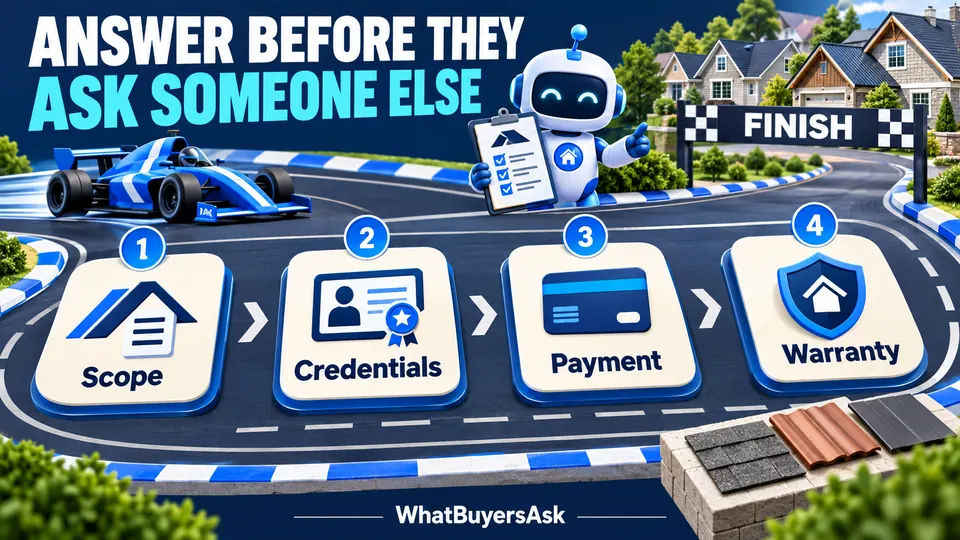
Answer before they ask someone else: scope, credentials, payment and warranty.
An effective estimate page explains scope in plain language. A homeowner should be able to see whether the quote includes removal, disposal, underlayment, flashing, ventilation and possible decking work, where applicable. Explain which items are fixed and which need an inspection. This helps people compare proposals without reducing the decision to the lowest headline price.
Put verifiable credentials beside the next action. Use the company's actual legal name, service area, relevant licence details and an appropriate verification link. Explain how a homeowner can request insurance documentation. Publish the real payment schedule and distinguish workmanship cover from manufacturer warranties. The BBB's roofing guidance gives useful context on checking contractors, written terms and payment arrangements.
Insurance content needs particular care. Explain the company's inspection and documentation process without promising that a policy will pay or that a claim will succeed. Coverage, deductibles and who may negotiate a claim depend on the policy and local rules. Have the relevant qualified person review this copy before publication; the homeowner's insurer remains the source for their coverage decision.
Keep the Google Business Profile factual under Google's business guidelines: accurate name, categories, hours and service area. Review existing listings and trade profiles for contradictions. Only claim certifications, locations and emergency availability the company can support. A profile should help someone verify the business they are about to contact.
To create a manual baseline, ask the same five prompts in three relevant AI services, such as ChatGPT, Perplexity and an available Google AI search experience. Save the answer, service, date, time, location and cited sources. Record whether the company is mentioned, whether a company page is linked and whether the details are accurate. A list of contractors and an explicit recommendation are different observations.
Expect up to 15 answers from that first pass, with unavailable results recorded separately. Repeat the same questions before treating a result as a trend. BrightLocal's local AI study found variation across repeat searches and locations. If a competitor appears, inspect the cited evidence rather than assuming a single missing keyword explains it.
Use the results to agree a practical month of work:
- Week one: save the baseline and correct wrong phone numbers, service areas, hours or business details.
- Week two: create a clear estimate explainer and a page showing how customers can verify the company's credentials.
- Week three: improve the pages for the jobs the company wants, with genuine local project evidence and useful answers about scope and warranties.
- Week four: rerun the fixed prompts and review inspection requests, qualified enquiries and accepted proposals alongside visibility findings.
Ask for feedback neutrally: “Thank you for choosing us. If you would like to share your experience, you can leave a review here: [review link].” Follow Google's review policy. Use the customer's own words rather than asking them to include a town, service or preferred claim.
We rank well on Maps. Why might an AI answer omit us?
Treat Maps performance and the observed AI answer as separate measurements. Check the question, location and cited sources. Strong performance in one result does not guarantee inclusion in another.
Should we publish a roof replacement price?
Publish prices or ranges only when the business can support them and explain their scope. A clear breakdown of the inspection and quotation process is more useful than a number that does not apply to the reader's roof.
Which directories should we prioritise?
Start with accurate existing profiles and the relevant sources cited in your market. Consider trade associations and consumer directories where appropriate. Paying for a listing does not establish that an AI service will recommend the roofer.
Can better answers guarantee more roofing jobs?
No. They can make an estimate easier to understand and a business easier to evaluate. Track enquiries and accepted work separately. Google's AI search guidance does not promise inclusion for any particular site.
Can we check whether AI bots can reach the website?
Use the public AI bot reachability checker. If WBA CLI is installed, run wba https://example.com, replacing the example with the client's public website. It checks access, bot instructions and readable page text without a login or research credits. It does not measure whether the business is mentioned or recommended.
How can WhatBuyersAsk help our agency?
WhatBuyersAsk uses a library of buyer question patterns to select 40 critical questions around the client's business, including costs, alternatives, comparisons and trust. The research helps you inspect answers, competitors and gaps before deciding which pages deserve attention. Read how the research process works and review the proposed scope for your client.
Can we keep the questions fixed for a retest?
Keep the agreed wording, market and question version with the baseline, and compare later observations against that same set. If you add questions, report them separately so a changing denominator does not look like an improvement. The portal's raw research download lets you retain saved answers and available scores with their provenance; unavailable evidence should remain visible as unavailable.
Create your agency workspace to turn your client's unanswered questions into a clear research brief and a next step supported by evidence. Existing customers can sign in. Start with the questions that stand between the next enquiry and the next competitor.