
A buyer or seller can compare agents before your client knows they are in the market. They may ask an AI assistant how to choose a listing agent, what representation includes or whether a lower-fee service meets their needs. If the useful answers point elsewhere, another agent can earn the first conversation.
For an agency, this is an opportunity to make the agent's experience and service easier to assess. Explain how they work, which property types and areas they serve and how clients can discuss fees. Help a prospective customer picture the process from the first meeting to the next decision.
“Best agent near me” is only one part of that journey. Sellers want to understand the pricing approach, marketing plan and evidence behind an ambitious suggested asking price. Buyers may be uncertain about representation, written agreements and who pays which fee. A good website makes those conversations easier to start.
Adapt these example prompts to the agent's actual market:
- How do I choose an agent to sell my home in [town]?
- What should I ask when interviewing listing agents with experience in [area]?
- How are this agent's fees agreed, and what services are included?
- Which agents serving [town] can explain a pricing and marketing plan for my property type?
- How should I compare a flat-fee or limited-service option with full representation?
Add buyer questions about whether to use an agent, how compensation is agreed and what it means to approach the listing agent directly. Include relocation and new-build questions if the agent actually provides those services. Keep representation and compensation explanations current for the jurisdiction and the agent's agreements. NAR's settlement FAQs provide US context on negotiable compensation and written buyer agreements; local requirements still need professional review.
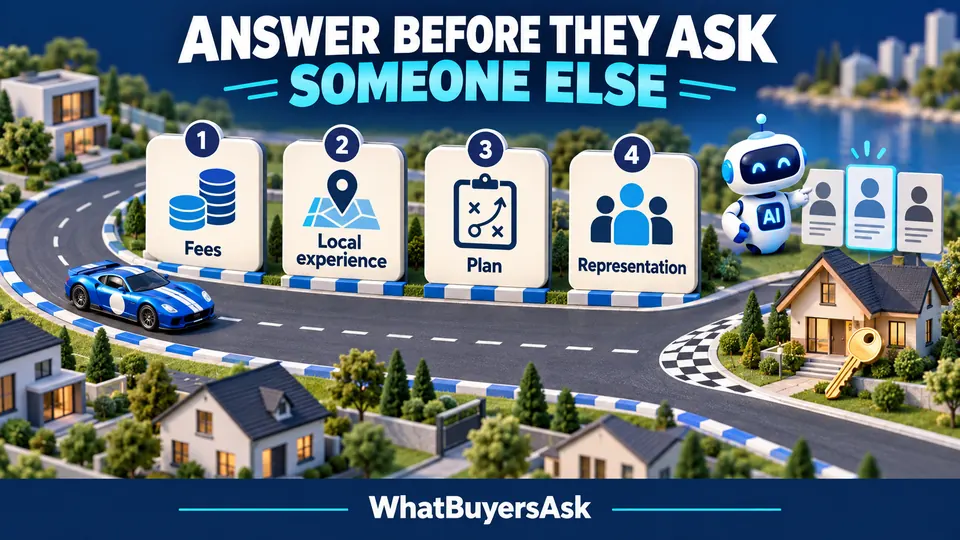
Answer before they ask someone else: fees, local experience, plan and representation.
Translate expertise into details someone can inspect. A seller page can explain how comparable properties inform a pricing discussion, what the marketing plan covers and how the agent communicates progress. A buyer page can explain the search, offer and inspection process without making promises about financing, appreciation or a particular outcome.
Use local evidence carefully. Include accurate recent transactions where permission and applicable rules allow, the agent's role and the date. Explain relevant property experience rather than relying on a list of town names. Keep community information objective and sourced, and have the brokerage review marketing for applicable fair housing and advertising requirements.
Make fees understandable without inventing a standard rate. Explain when the agent discusses compensation, what the proposed service includes and how the agreement is documented. If a price or transaction statistic changes, update the page and its date. A precise explanation is more useful than a claim that every client will sell faster or achieve a higher price.
Check the Google Business Profile against Google's business guidelines: use the correct practitioner or brokerage identity, categories and location details. Compare the agent's website with existing portal and professional profiles. Correct an old brokerage affiliation, phone number or service area wherever it appears.
Build a manual baseline with the same five prompts across three relevant services, such as ChatGPT, Perplexity and an available Google AI search experience. Save the complete answer, service, date, time, market and sources. Record a named agent separately from a property portal that was merely cited. A source link to a portal is not automatically a recommendation to hire that portal.
That first pass gives up to 15 observations. Keep unavailable answers separate, then repeat the exact questions before drawing a trend. BrightLocal's local AI study observed variation across repeated searches and locations. Compare equivalent questions about the same area and client needs when assessing changes.
Use the findings to guide a month of work:
- Week one: record the baseline and reconcile the agent's identity, brokerage, contact details and areas served.
- Week two: improve the seller and buyer pages so the service, pricing discussion and representation process are clear.
- Week three: publish a useful local page supported by current, permitted evidence and answers to actual client questions.
- Week four: repeat the fixed prompts and review consultations, signed clients and attributable enquiries with the agent.
Keep feedback requests neutral: “Thank you for working with us. If you would like to share your experience, you can leave a review here: [review link].” Follow Google's review policy, and let clients decide which details to share.
Does naming the town in a prompt matter?
Location changes the question being asked. Test the towns or areas the agent really serves, keep them fixed for comparisons and save the market used with every observation.
Can an independent agent compete with a large brokerage?
Test what happens in that agent's market. Clear local experience, an understandable service and verifiable facts give people useful reasons to enquire, without relying on the size of the brokerage as a promise of visibility.
What should an agent's website explain first?
Who the agent helps, where they work, what the service includes and how the first conversation works. Support claims with accurate credentials and evidence the brokerage has approved.
Does schema guarantee an AI recommendation?
No. Google's AI search guidance requires no special AI schema. Make the visible information useful and accurate before treating markup as the answer to a missing mention.
Can we check whether AI bots can reach the website?
Use the public AI bot reachability checker. If WBA CLI is installed, run wba https://example.com, replacing the example with the client's public website. It checks access, bot instructions and readable page text without a login or research credits. It does not measure whether the business is mentioned or recommended.
How can WhatBuyersAsk help our agency?
WhatBuyersAsk uses a library of buyer question patterns to select 40 critical questions around the client's business, including costs, alternatives, comparisons and trust. The research helps you inspect answers, competitors and gaps before deciding which pages deserve attention. Read how the research process works and review the proposed scope for your client.
Can we keep the questions fixed for a retest?
Keep the agreed wording, market and question version with the baseline, and compare later observations against that same set. If you add questions, report them separately so a changing denominator does not look like an improvement. The portal's raw research download lets you retain saved answers and available scores with their provenance; unavailable evidence should remain visible as unavailable.
Create your agency workspace to turn your client's unanswered questions into a clear research brief and a next step supported by evidence. Existing customers can sign in. Start with the questions that stand between the next enquiry and the next competitor.