
Review Meta's updated Commercial Terms and your website's crawler settings as two related decisions. The official preview gives an effective date of 30 October 2026 and includes website-crawling language. Understand the text that applies to your business before treating a copied robots.txt snippet as a complete answer.
For an agency, prepare a short record the client can review: which Meta business products they use, which public domains are associated with them, what access is currently allowed and who owns the legal and technical decisions. That helps avoid a rushed change that removes useful previews or search access by accident.
What does the new text say about websites?
The official terms preview, checked on 17 October 2026, describes automated access to associated domains and periodic updates. It lists uses including research, training and product development. Its commercial scope includes activities such as managing a Page, rather than only purchasing advertising. The preview also describes continued business use after notice as agreement to updated terms.
Those are points to review in the actual agreement. This article does not determine enforceability, rights in third-party content or the effect of a technical rule on a contract. Give those questions to the organisation's legal owner, using the applicable terms and region. Keep the current terms and preview clearly distinguished until the effective date.
What are Meta's different crawlers for?
Meta's current crawler documentation separates purposes. FacebookExternalHit builds link previews; Meta-WebIndexer supports Meta AI search; Meta-ExternalAds supports advertising and business products; Meta-ExternalAgent covers model training or product indexing; Meta-ExternalFetcher handles user requests. The page also describes robots.txt exceptions for user fetching and security checks.
Avoid treating a request with any “Meta” name as one activity. A useful access decision identifies the crawler and purpose, then checks the result. Changing a training preference is different from deciding whether a shared link should display a title and image.
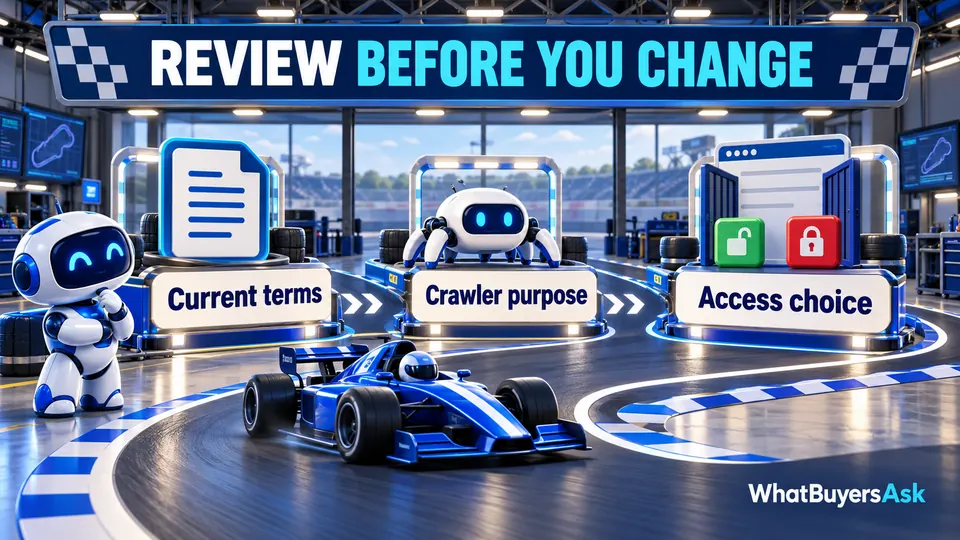
Review before you change: Current terms, Crawler purpose, Access choice.
Can I choose search access separately from training?
The documented crawler names allow different technical preferences. Decide what you want public service pages to do, then ask the site administrator to review the exact rules. A company may want useful public information discoverable while considering a different policy for training or other uses.
Keep the client's business purpose explicit. A local provider may depend on shared links and enquiries; a publisher may have different content-licensing concerns. Neither position should be inferred from the existence of a Facebook Page alone. Document the client's decision and retain the original settings for review.
How would a robots.txt preference be expressed?
A developer can add a crawler-specific group, preserving the rest of the file. For example, a preference against Meta-ExternalAgent accessing the site can be expressed as two lines: User-agent: meta-externalagent followed on the next line by Disallow: /.
That is an example for review, not a complete replacement file. Keep existing private-path restrictions, sitemap entries and other crawler rules. Named groups need careful review because a bot does not automatically inherit every restriction from the general group. Check the exact hostname and any redirected destination.
Does robots.txt provide a hard block?
It expresses crawler instructions. Authentication and appropriately configured server controls protect private content. Do not rely on a public text file to keep customer records, internal pages or paid information confidential. Check how the applicable crawler says it handles instructions and verify actual request evidence.
Robots preferences also do not amend the terms you accepted. Ask the legal owner to consider the agreement, while the technical owner verifies the response and configured rules. Keeping those responsibilities distinct prevents a technical test from being presented as a legal conclusion.
What should we check before changing settings?
Start with a small inventory of public pages and functions that matter to customers. Include the homepage, important service or product pages and a representative shared link. Record the existing rules, response behaviour and preview appearance before the administrator makes an approved change.
- Save the applicable terms link and review date.
- Identify the business products and public domains in scope.
- Map each relevant crawler to its documented purpose.
- Review robots instructions and hosting controls together.
- Test the specific behaviour after an approved change and record the result.
Use actual logs and the operator's verification guidance where available. Anyone can copy a user-agent name, so a successful request carrying that name does not prove that Meta's real crawler can access the page. Likewise, a simulated failure does not prove a genuine crawler is blocked.
Should we block every AI crawler?
Make a purpose-based decision instead of copying a universal blocklist. Some controls relate to discovery, some to training and some to a user's requested action. The website access guide explains why those checks should be recorded separately.
Whatever policy is chosen, keep public prices, offers, service areas and contact details accurate. Those are the facts a prospective customer needs when they reach the business from a shared link, search result or AI answer.
When do the updated terms take effect?
The official preview displays 30 October 2026. Recheck the applicable page before making a business decision, because this article records the preview available on 17 October.
What is Meta-ExternalAgent?
It is a documented Meta crawler with training and product-indexing purposes. Review it separately from the search, advertising, preview and user-fetch identities.
Should we keep FacebookExternalHit allowed?
Review the link-preview behaviour your business wants to support. Test a representative shared page and follow the current documentation before changing access. Do not assume that blocking all Meta identities is consequence-free.
Can a reachability tool settle the terms question?
No. It can help inspect the observed HTTP response, robots instructions and readable page text. It cannot interpret your contract or prove actual crawler identity.
How does this connect to winning enquiries?
Once the access policy is clear, inspect whether the pages answer the buyer's service, cost and trust questions. A readable page still needs useful, current information and a clear next step.
WhatBuyersAsk helps agencies organise those questions and inspect saved research evidence. Review the research process, create your workspace, or sign in to continue with a client.