An AI assistant can recognise your business and still leave you out when someone asks which provider to choose. Recognition shows that your name can appear in an answer. A recommendation needs to fit the buyer's situation. Start by checking the question and the evidence behind the answer before deciding what to change.
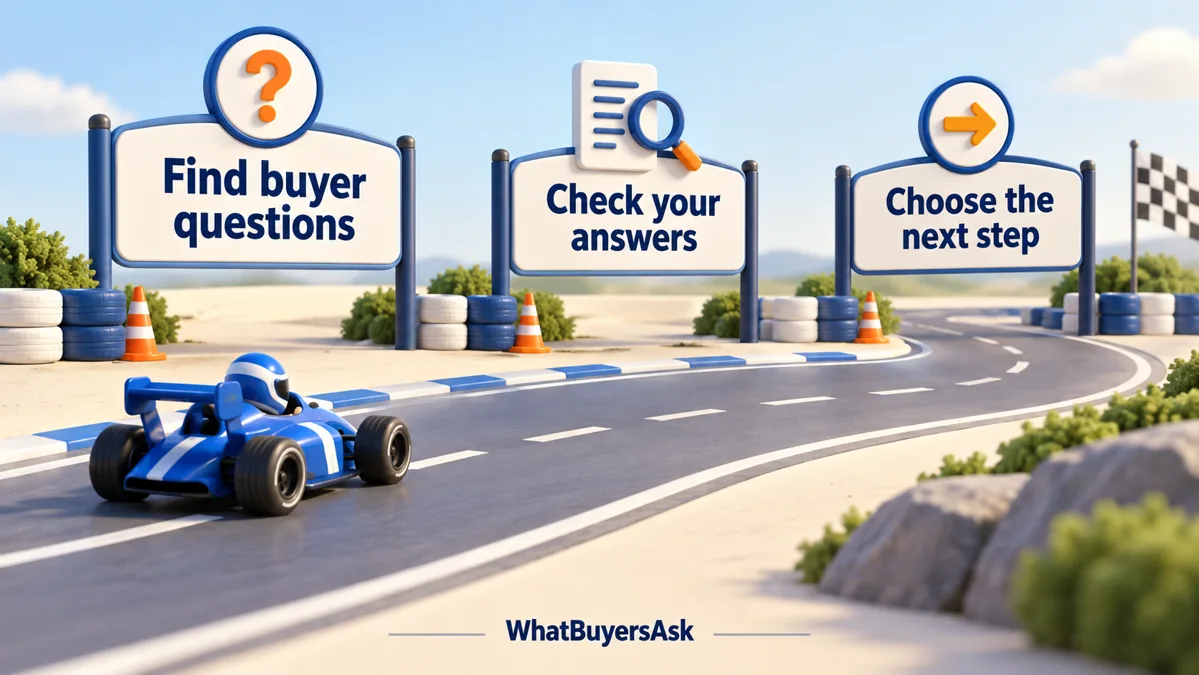
Imagine a business owner asking ChatGPT or Perplexity, “What does Acme do?” A reasonable description of Acme would show that the assistant can identify it. Now imagine the owner asking, “Which provider can help a small team move its customer records without a long interruption?” This question needs information about the service, the team, the move and the risks. Acme's name appearing in the first answer does not establish that it will appear in the second. Acme is an illustrative business in this example.
Check both kinds of question. Use your business name to inspect whether the description is accurate. Then ask the questions a buyer would ask before knowing whom to choose. Include the service, location, budget or other conditions that genuinely matter. Save the wording so you can repeat the observation later.
Treat ChatGPT, Perplexity and Google's AI Overviews as separate places to observe. An AI Overview may not appear for a particular search. Record that result as unavailable for that question. A recommendation on one service does not establish what another will show. Google's guidance describes how its generative search features depend on search fundamentals; it offers no guaranteed route into an answer.
When a competitor appears, open the linked pages. Read what they actually support. The assistant may have used a product page, an independent comparison, a directory or a detailed explanation of the buyer's problem. Record the passage that matters, along with the source address and the date you checked it. This gives you a concrete content question to investigate.
Ask what a prospective customer can learn from that source. Does it explain who the service suits? Does it state a limitation, show an integration or describe the work involved? If your website leaves the same point unclear, improve the page closest to the buying decision. A migration question often belongs on the migration service page. A contract question may belong in the pricing or purchasing explanation.
A useful answer can include conditions as well as benefits. Explain what the customer must supply, which situations need a different approach and which costs are outside the quote. Use a demonstration, documented process or customer example only when you have evidence and permission to support it. Correct inaccurate business descriptions on legitimate external profiles too.
Repeated mentions and paid placements do not prove that a claim is true or that an assistant will recommend your company. Evaluate coverage for its relevance and usefulness to customers. A source that supports one answer does not reveal every reason the assistant selected it.
Repeat the original questions after recording your page changes. Keep the service, wording and relevant context consistent. Review more than one observation before calling a result an improvement, and track relevant enquiries alongside appearances. A mention, a source link and an explicit recommendation should remain separate in the record.
Does being named mean we are recommended?
Read the surrounding sentence. A list of businesses, a passing reference and advice to choose a provider have different meanings. Record what the answer actually says.
Should we copy the competitor's article?
Use it to understand the missing information, then explain your own offer with evidence. Copying the wording will not establish that your service fits the same buyer.
How can WhatBuyersAsk help?
Buyer question research helps define what prospects need answered. Answer gap analysis and competitor insights connect those questions with pages and evidence to inspect. These findings support a content decision; they do not promise a recommendation from an AI service.
Book a conversation about your answer gaps. Bring one buyer question and the answer that named a competitor so the next step starts with something concrete.