
Write down 20 to 30 questions your buyers need answered before they choose a provider, then save the answers they can find today. This starting record gives you a useful baseline: a clear view of the questions, the current evidence and the gaps you want to improve.
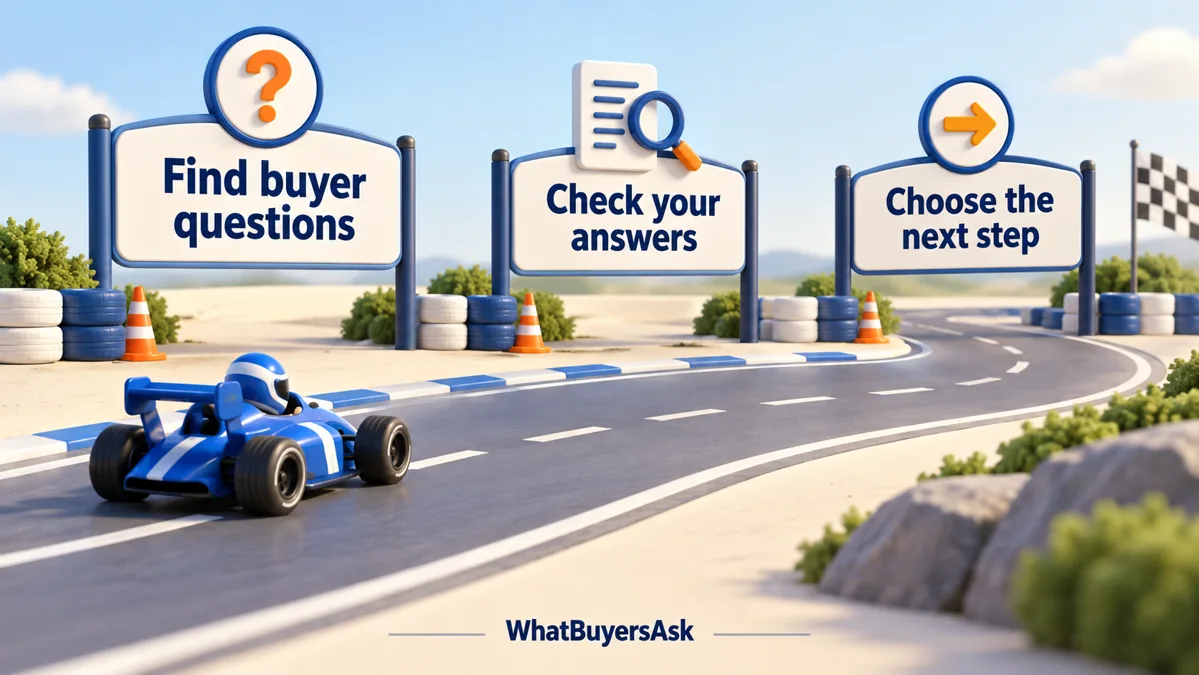
Choose one product or service, one audience and one market. A training provider serving individual learners has different buying questions from one selling company programmes. Keep the first exercise small enough that someone on your team can read every answer and inspect the important sources.
Collect questions from recent sales conversations, support requests and customer interviews. Ask the people who speak to customers which questions delay a decision. Keep the wording close to what customers say. Where you have no customer evidence, label a proposed question as a working assumption so it can be checked later.
Use the following 25 questions as a starting worksheet. Adapt the wording to your offer. The count is a manageable sample for this exercise, not a requirement from ChatGPT, Perplexity or Google.
- What problem does this service help us solve?
- Who is it suitable for?
- Which outcomes can we reasonably expect?
- What do we need in place before starting?
- When would a different approach make more sense?
- Which alternatives should we consider?
- How does this compare with doing the work ourselves?
- What changes when we choose a lower-cost option?
- Which differences matter for a team like ours?
- What should we ask when comparing providers?
- What evidence supports the main claims?
- Can we see how the service works before committing?
- What relevant experience can the provider demonstrate?
- What limitations should we understand?
- How will we agree whether the work succeeded?
- What does the price include?
- Which additional costs might arise?
- How long are we committed for?
- What security or purchasing requirements must be met?
- What happens if our needs change?
- How long does getting started usually take, and what affects it?
- Who does each part of the work?
- How will this fit our existing tools or process?
- What support is available during the change?
- What do we need to maintain after launch?
Now choose the questions with the greatest effect on a real buying decision. Mark whether each came from a customer conversation or an assumption. Add the website page that should answer it and a short note explaining why the question matters. You can do this in a simple spreadsheet.
For questions about the market, use the same wording in ChatGPT and Perplexity and inspect the relevant Google results, including an AI Overview when one appears. Save the date, service, language and location where relevant. Record the actual answer, businesses named and linked sources. Use a fresh conversation where possible and note whether web search was enabled. If an AI Overview is absent or a request fails, record that condition separately.
Check questions that mention your business as a separate accuracy exercise. Keep the main discovery set focused on the buyer's need so you can see which providers appear before the buyer knows your name. Do not silently replace difficult questions with easier ones when you repeat the exercise.
Open your own relevant pages and assess what a buyer can learn. A page may answer a question fully, partly or leave it unresolved. Add the source passage that supports your assessment. Choose a small number of improvements that remove the clearest uncertainty, then save what changed and repeat the observations.
The free buyer research tool is the starting page for requesting website research. At the time of writing, free research intake is paused. You can complete this worksheet now and check that page for availability. When intake is open, its research can supply starting material to review and refine; it does not replace your own fixed question set or automatically establish visibility across all three services.
Why use 20 to 30 questions?
It is enough to cover several parts of a buying decision while remaining practical to review manually. Expand the set when you can maintain the evidence and explain what the added questions cover.
Do I need to use commands?
The worksheet and website are enough for this exercise. Teams using the installed WhatBuyersAsk CLI can run wba status to check their connection and wba clients list to inspect accessible clients. Those commands do not run an AI visibility test.
What does WhatBuyersAsk add?
Its buyer question research, website answer analysis, competitor evidence and saved reports help turn a question set into page priorities. See the research approach, or discuss one important buying decision with the team.